


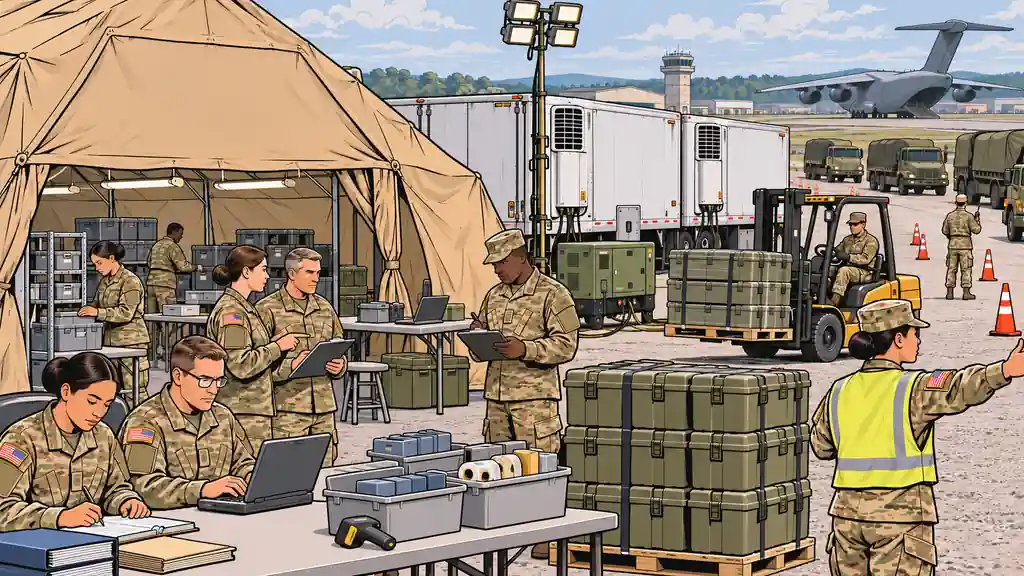
Over the last century, warfare has evolved in many ways. One critical aspect that has changed is one that isn’t considered by many — how casualties are managed. The US military is quietly undertaking concerted efforts to re-enable the methods last used 75 years ago. This is telling as it means that military is preparing for a kind of warfare not seen since World War 2.
Modern methods
Beginning during the Korean conflict, the way casualties were handled changed. The military adopted what became known as the Concurrent Return Program, where the remains of those killed in action were returned immediately to the United States. This was done through advances in refrigeration, closer proximity of infrastructure to the battlefield, improvements in aircraft, and a host of other innovations and changes to the way the military operated. This began in 1950 and has continued to today. Along the way, three generations of warfighters have come and gone, and as a result, the “old ways” have been lost.
Old methods
Prior to 1950, the remains of those killed in action were handled in a much different way. The military used what they called “temporary internment” — they buried the troops in mass, temporary graves. Once the battle ended, or it was otherwise safe to do so, the bodies were dug back up and returned to the United States.
Operation Dragon Covenant
Operation Dragon Covenant Phase II was conducted at Fort Bragg, North Carolina, on October 20-21, 2026. During the exercise, soldiers from the 3rd Corps Sustainment Command and 20th Engineer Brigade at Fort Bragg, North Carolina, tested procedures for handling large numbers of battlefield fatalities during a future high-intensity conflict. While mortuary-affairs units have trained on aspects of temporary internment periodically, this was something that none had ever actually practiced or tested.
The exercise involved digging and backfilling simulated temporary interment trenches using bulldozers and excavators while ensuring remains could later be recovered, identified, and returned to families. Simulated skeletal models and water containers were used instead of actual remains. Army planners estimated that with 8 bulldozers and 4 excavators, they could process temporary interment for up to 2,400 casualties in 24 hours.
Army officials stated the goal was to validate fatality-management doctrine for a future war where immediate evacuation of remains might not be possible, unlike recent conflicts in Iraq and Afghanistan. During future conflicts the U.S. may not have air superiority and secure logistics corridors like it has over the last 50 years. The exercise was designed to rehearse operations when large numbers of casualties accumulate faster than they can be evacuated. The Army has already announced a Phase III exercise planned for Spring 2027, incorporating security, medical facilities, and mortuary affairs collection points, so this was not a one-and-done exercise.
Why it matters
This operation is one piece of a larger puzzle that is emerging where the US military is transitioning from preparations for counterinsurgency warfare to to what it calls “Large-Scale Combat Operations” (LSCO) against a military peer. To put it into layman’s terms, the military is planning to fight a war against a military power equal to our own, and it generally points to Russia, China, or both being the focus.
Russia:
- The war in Ukraine demonstrated casualty rates far higher than those experienced during Iraq or Afghanistan.
- Artillery, drones, missile strikes, and electronic warfare have made movement and evacuation more difficult.
- Medical evacuation timelines can stretch from minutes to hours or days during high-intensity combat.
China:
- A conflict in the western Pacific could involve dispersed forces across islands.
- Airfields and ports could be targeted early.
- Sea and air transportation capacity could become constrained.
- Recovery and evacuation operations could face long delays.
Regardless of the reason, it’s clear that the US military is preparing for the situation where they suffer casualties at a rate that cannot be managed using the current methods. This points to a dramatic increase in the severity of future warfare for the United States.
Bottom Line
- Prior to 1950, the US utilized temporary internment for those killed in action.
- Over the last 75 years, we have utilized concurrent return, where KIA were returned to the US promptly.
- The Army is resurrecting the old methods and testing them using modern equipment and personnel.
- This points to a possible future increase in the death rate for US soldiers during combat operations abroad.
Put a real number on your own resilience with the Food & Water Storage tool and the Heating & backup-power calculators, and rate the scenario with the War with China threat brief.