


I’ve started writing this article three times and major news comes in as I’m working on it — things are moving that fast. I’m drawing a line in the sand and releasing it based on my information at this point, but I guarantee it’s not complete due to the speed and scope of the events that are occurring around the world (and there’s so much info it could fill multiple articles at this point).
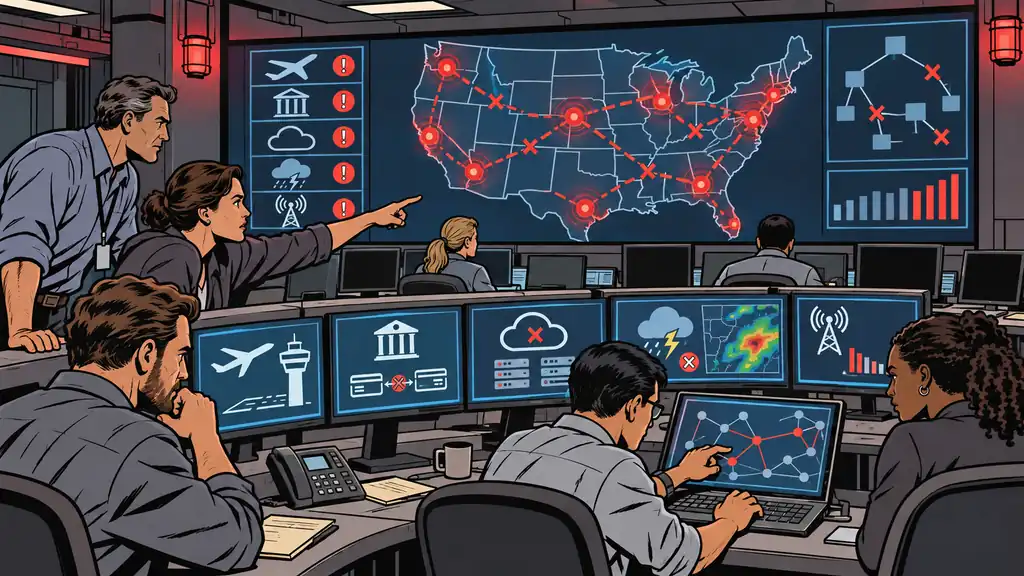
Thursday, November 12th kicked off a series of events where networks and other computer systems have been disrupted across all sectors of the economy. During and since, there have been rampant speculation surrounding these events, with many believing that these were the result of a rogue AI or a cyber attack by Iran or another party upon the United States. Unfortunately, there are no clear answers here — most of the evidence I’ve found is circumstantial at best. As a result, I can’t give a concrete answer, but instead will lay out the facts as I know them for some of the various events. Here’s a list of the events over the last few days:
- November 12: Microsoft cloud outage
- November 13: FAA ground stop
- November 16: JPMorgan Chase banking outage (with spillover effects seen by customers of other banks)
- November 16: United Airlines system outage / ground stop
- November 17: NSA internal communications network outage (yes, the government intelligence agency)
- November 17: Apple services outage (Apple Pay, App Store, iCloud, activation services, support tools)
- November 17: The National Weather Service (NWS) had a 40-minute disruption of websites and data services
- November 17: Charles Schwab outage
- November 17: Gmail users are reporting a disruption of services even though Google says there is no issue
An interesting thread through all of these events is that in every single one, the cause was specifically said to not be cyberattack or due to AI intrusion. This means that we’ve had significant failures of critical systems seven separate times in a period of five days, but it was just a massive coincidence.
“Once is happenstance. Twice is coincidence. The third time it’s enemy action.” - Ian Fleming, in the 1955 James Bond novel Goldfinger
If three times is enemy action (an attack), what does nine times mean?
The lead-up: an Iranian “deadline”
I have seen multiple places online citing that November 11-12, 2026 marked a “deadline” that had been set by Iranian leaders. They apparently required that the U.S. agree to their seven conditions for an end to hostilities by this date, “or else”. Amongst various statements leading up to those dates were a variety of vague threats:
- Iranian forces would “rain down hell” on American targets in the region — Abbas Araghchi, Iran’s foreign minister
- “We may even target some American military bases in European countries.” — Mohsen Rezaei, secretary of Iran’s Supreme National Security Council
- Senior Iranian military officials stated that retaliation would not be geographically limited and warned that American interests could be targeted globally.
While this third point has been used as reasoning for why Iran could have done this (and I’m not saying they didn’t), I do want to point out that these threats are vague, and are in line with the threats that have been made nearly continuously for the last seven months. There’s an additional point on the “deadline” that must be understood as well — there wasn’t one.
- On November 1st, Abbas Araghchi said Iran would act “within 7 days” if the US met demands. This is Iran saying that they would act quickly once the US agreed.
- On November 9th, Mohsen Rezaei and other Iranian officials were publicly stating that Iran would only reopen the Strait of Hormuz after the U.S. met Iran’s seven conditions
- On November 10, Iranian officials stated they were still waiting for a clear U.S. response to the seven conditions and emphasized that negotiations could not proceed until those conditions were addressed.
- On November 11-12 (the deadline), senior Iranian officials, including Mohammad Bagher Ghalibaf and Mohsen Rezaei, publicly complained that Washington had not formally responded to the seven conditions.
So, we have a pattern of Iranian leadership complaining that the U.S. was ignoring them. And on the day of the supposed “deadline”, the leadership continues to complain. But amongst all this, I have yet to find a single date being set or even mentioned by the Iranians. While they may have set one through “back channels”, I’m skeptical of that as they’re so vocal about other things (am I the only one that thinks the Iranians are acting like middle school girls?), so I doubt they would keep this secret . As a result, I don’t believe that there was ever an Iranian “deadline” at all.
The best I’ve been able to find is that this claim started with a Reuters article on November 9th. In it, they mention Abbas Araghchi’s comments from November 1st and added his comment that they would be willing to restart talks in as few as two days if conditions were met. I believe that the internet ran with this as a “deadline” for the 11th, even though there never was one…
Microsoft outage
Beginning around 11:20 AM ET on Nov. 12th, a large portion of Microsoft’s cloud ecosystem (Azure) suffered major disruptions to services that included e-mail (Outlook), Teams, 365, Copilot and Power BI. This meant that many users were unable to access email, send messages, use calendars, or access Microsoft-hosted business applications. I can attest to the outage as it affected me — my employer uses Microsoft in most of these areas. This was the single largest outage in Microsoft history, and lasted over 24 hours for some customers. While impactful, this wasn’t the first of such outages that have been experienced over the last few years, or the worst:
| Event | Date(s) | Scope | Duration | Severity |
|---|---|---|---|---|
| Google Cloud authentication / control-plane disruptions | Monday, December 14, 2020 | Multiple Google services and dependent apps | Hours | High |
| Amazon Web Services US-East-1 outage | December 7-8, 2021 | Large portion of internet services dependent on AWS | Several hours to >24 hours for some services | Very high |
| CrowdStrike faulty update | Friday, July 19, 2024 | Millions of Windows endpoints worldwide | Hours to days | Extreme |
| Microsoft cloud outage | November 12-14, 2026 | Outlook, Teams, Microsoft 365, SharePoint, OneDrive, Copilot, Intune, Power BI, Defender | More than 24 hours for some customers | Very high |
Microsoft has publicly stated that the outage was not caused by a cyberattack or AI systems. The company claims that they traced the incident to a networking failure involving:
- A latent software bug introduced during a networking gateway update in July 2026.
- A subsequent network traffic reallocation/change that increased load on affected systems.
- Reduced server capacity due to maintenance activities.
Together, these conditions triggered a “cascading failure” that eventually rendered more than 80% of Microsoft’s networking gateway servers unresponsive.
Now, I’m not a cyber-security expert, but I do have considerable computer and networking experience. In my opinion, their explanation leads me to one of three conclusions:
- They’re grossly incompetent.
- They’re lying.
- They’re incompetent AND lying…
Unfortunately, it’s impossible to know which. While I have distain for Microsoft as a company, they’re one of the most experienced companies in the tech sector. They’ve been the backbone of business software for more than 30 years (Windows and Office). In addition, they have significant market share in both server operating systems (~25-35%) and cloud computing providers (~23-25%). For them to have a bug of this magnitude, which took so long to fix, leads me to believe there’s much more we’re not being told.
Airline ground stop
On Friday, November 13th, the FAA issued a nationwide ground stop. This was one of the most significant disruptions to U.S. aviation since 9/11. Around 3:30pm ET, the FAA detected instability in radar and communications systems used by air traffic control. Around 4:00pm ET, the FAA issued a ground stop — this meant that no aircraft were allowed to take off. As an important distinction, the more than 3,500 aircraft that were airborne over the U.S. were allowed to continue to their destinations and all landed safely. At 8:15pm ET the FAA lifted the ground stop and normal air travel was allowed to resume. Now that we have the key facts about this event covered, let’s compare against other events as well to get a better context around what occurred.
This wasn’t the first ground stop that’s been issued in the U.S. — it’s the 6th.
| Date | Event | Duration |
|---|---|---|
| October 10, 1960 | Operation Sky Shield I — Simulated Soviet nuclear bomber attack | About 12 hours |
| October 14, 1961 | Operation Sky Shield — Follow-on continental air-defense exercise involving widespread grounding of civilian traffic | About 12 hours |
| September 2, 1962 | Operation Sky Shield III — test readiness against a mass Soviet bomber attack | About 12 hours |
| Sept. 11, 2001 | Ground Stop Order and closure of U.S. airspace after terrorist attacks | 2-3 days for all commercial traffic |
| Jan. 11, 2023 | FAA NOTAM system failure, prevented pilots from receiving required safety notices. | About 90 minutes |
| Nov. 13, 2026 | Nationwide FAA ground stop | About 4 hours |
The first three were large-scale military readiness exercises during the height of the Cold War. In them, all aviation in the United States and Canada was halted so that the military could test readiness against a nuclear bomber attack from Russia. The fourth is an event I’m sure all of you reading this are familiar with. The fifth is the one I want to focus on a minute as it’s the most like what just happened.
NOTAM stands for Notice to Air Missions and is the system pilots use before every flight to receive critical safety information such as runway closures, temporary flight restrictions, construction activity, lighting outages, hazard warnings, etc. Federal regulations require pilots to review applicable NOTAMs before departure. Sometime during the night of Jan 10th into the 11th, a contractor unintentionally deleted files while synchronizing data between the primary and backup NOTAM databases during routine maintenance. The deleted files corrupted the system, causing it to distribute incomplete safety information. The FAA began using backup systems around 3:28am ET, but the issues continued to worsen and departures were paused at 7:30am. At 9:00am the FAA issued a ground stop and within the hour the problem was resolved and the ground stop was lifted. Thankfully, this incident mostly occurred overnight, so the impact was minimized.
At this point, it appears that L3 Harris is largely being blamed for Friday’s ground stop. They had recently replaced a router in a communications facility in El Dorado, Arkansas. Additionally, a radar facility in Amarillo, Texas is said to also be a contributor. Apparently, routers and switches on the FAA telecommunications network began receiving an abnormally high volume of network connections and started returning inconsistent information to air traffic control systems. The legacy communications equipment became unstable after receiving roughly 1,000 connection attempts every 4-5 seconds as per the FAA.
As I mentioned above, I have computer and networking experience. Based on what I’ve been able to find, the problem sounds as simple as a router being installed with an IP address that was a duplicate of another on the network (possibly the Amarillo site). I’ve seen this mistake cripple a network before, and it’s not an easy one to troubleshoot in a distributed network like the FAA has (an administrator in Washington DC has no idea that a router was just replaced in Arkansas). This is made much worse as it’s older hardware that doesn’t prevent issues like this through proper network segmentation, etc. Now, this kind of issue is also easy for an attacker to initiate — they just have to change one device IP address.
Other Examples
Now, I’m not going through the other seven events with the same analysis — you’d fall asleep long before you’d reach the end. The key takeaway is that they’re all similar. Every one are network disruptions with stated causes that are plausible, isolated and benign. While they all could be part of a giant coincidence, it’s extremely unlikely.
White House messaging
The entire episode was “complicated” somewhat by a statement by Markwayne Mullin, the Department of Homeland Security Secretary (DHS). During a White House press briefing during the midst of Friday’s ground stop, he said, “This is what the Department of Homeland Security is all about. This is why we were stood up, to have a continuity of government to bring all the resources together in an emergency like this… This is a national emergency. We have all of our assets, be it from CISA, to all of our NOCs, and all the other components we have inside of DHS. NSA is working with us.”
He was dumb for using the words “continuity of government” in a situation like this (it got the attention of everyone with a tin foil hat, me included), but if you remove that phrase the point he was making becomes obvious. He was stating that DHS was bringing all available resources to bear in order to solve the problem quickly. Now, could his mention of “continuity of government” been a Freudian slip? Given the events since, I can’t rule it out.
Unfortunately, Mullin made additional incendiary statements on Monday when he told Sean Hannity during an interview that the theory that AI or a “super intelligence” contributed to the cascading service failures came up during a briefing with prominent technology experts. I wonder if he said the quiet part out loud in this interview, and actually told the truth for a minute. This morning he backtracked, saying that there is “no cyber threat that’s taking place”.
I’m a country boy, and there’s an old saying, Where there’s smoke, there’s fire. For the head of DHS to mention “continuity of government” as well as officially bring an AI “super intelligence” into the conversation is worrisome at best.
Bottom Line
- The “official” story is that it’s all a massive coincidence — and it’s possible that it is a coincidence.
- But given the number and scope, it’s increasingly likely that there’s much more than a coincidence going on. The question then becomes who/what is behind it.