


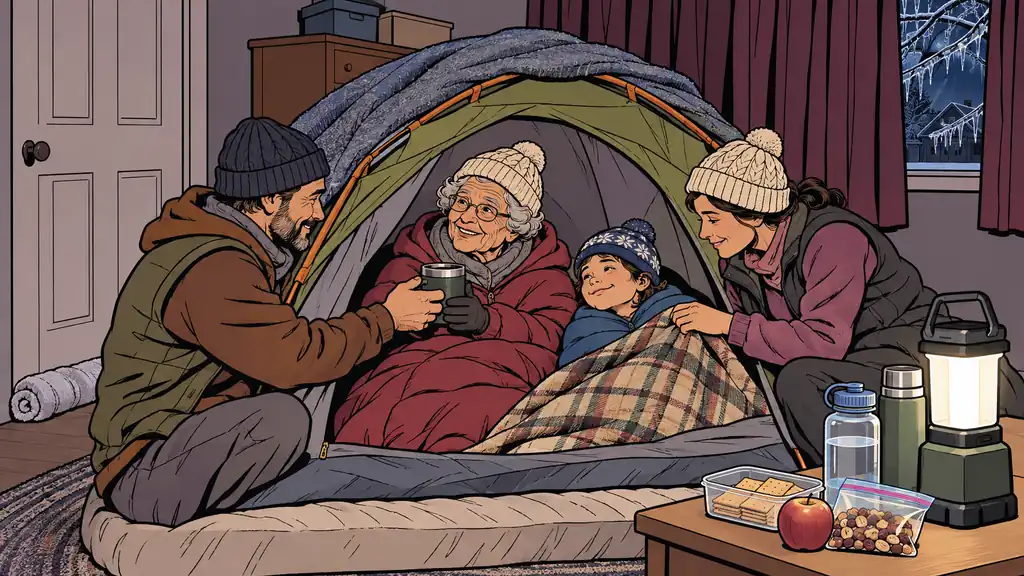
When people imagine an ice storm with the power out, they picture the whole house going cold and themselves powerless to stop it — and that mental image is exactly what makes them freeze up instead of prepare. It feels like an all-or-nothing problem: either you can heat 2,000 square feet or you can’t, and if you can’t, you’re doomed. But that’s the wrong frame. In a heat emergency you are not trying to keep a house warm. You’re trying to keep people alive, and people are small. The survival answer isn’t a bigger heater. It’s one room, made smaller, and held warm enough for bodies to be safe — a fallback that works even when you have no fuel and no generator at all.
This is the piece of ice-storm prep that costs almost nothing and gets skipped precisely because it’s not a purchase. It’s a technique. And it’s the layer underneath every other heating plan — the thing that keeps your family safe if the generator won’t start, the propane runs out, or the outage simply lasts longer than your fuel does. Everyone should have a heater plan. Everyone also needs the no-fuel fallback, because heaters and fuel can fail and the cold won’t wait.
The point isn’t comfort — it’s staying out of the danger zone
Start with what you’re actually defending against, because it changes the whole target. You are not trying to be comfortable. You’re trying to keep every person’s body temperature safe — to stay out of hypothermia, where the body loses heat faster than it makes it and starts shutting down.
A house with no heat in freezing weather doesn’t drop instantly; it cools toward the outdoor temperature over hours, faster as the night goes on. That’s your working clock. The danger isn’t the first cold hour — it’s hour twelve, hour thirty-six, the second and third night when the house has fully given up its stored warmth and the indoor temperature is tracking the outdoor one. And the danger isn’t spread evenly across the family, which matters enormously for how you plan.
Who’s actually at risk — plan for them, not the average adult
Cold is not an equal threat to everyone under the roof. Build your warm-room plan around the most vulnerable person in it, not the healthiest.
- Infants and small children lose body heat faster than adults — more surface area for their size, less ability to regulate, and they can’t always tell you they’re in trouble. A room temperature that’s merely unpleasant for an adult can be genuinely dangerous for a baby.
- The elderly regulate temperature less effectively and often feel the cold less than they should, which means they can slide toward hypothermia without the obvious warning of feeling freezing. Certain common medications and conditions make this worse.
- Anyone sick, injured, or on certain medications may have a blunted ability to hold body heat.
The practical takeaway: if there’s a baby, an elderly parent, or someone unwell in the house, your warm room has to be warm enough and reliable enough for them, and they get the warmest spot in it. Everyone else can layer up; the vulnerable can’t compensate the same way.
How to build the warm room
The whole strategy is to stop fighting the house and instead concentrate your people and whatever heat you have into the smallest defensible space. It works in a rough order.
1. Pick the right room. Choose a small interior room — a bedroom, a small den. Small means less air to keep warm; interior means it shares walls with other heated space instead of the outdoors, so it loses heat slowest. It’s the same science that makes a multi-pane window more efficient, but instead of glass you’re using walls. Avoid rooms with big windows or lots of exterior wall. One room, one door, minimal outside exposure.
2. Shrink it further. Close the door. Close off unused space beyond it. If the room is still large or drafty, you can make an even smaller pocket inside it — a tent, a blanket fort over a bed, a canopy — because a smaller volume warms from body heat alone and holds it. Trapped air is insulation, and your bodies are the heat source.
This sounds childish, but it’s genuinely effective — a dome tent sitting on top of a bed with blankets over the tent is a great shelter within a shelter.
3. Insulate against the cold surfaces. Block drafts under the door with a rolled towel. Cover windows with blankets or curtains to slow the heat bleeding through the glass. Get up off the floor — a cold floor pulls heat out of you fast, so pile blankets, cushions, or a mattress underneath, not just over.
4. Layer the people, not just the blankets. Bodies stay warm through trapped air, so many light layers beat one thick one, and a hat matters more than people expect because a lot of heat leaves through the head. Dress for the cold indoors: base layers, a warm mid-layer, hat, dry socks. Stay dry — damp clothing pulls heat out of you, so change out of anything sweaty. Cold-rated sleeping bags are the single best sleep-warmth investment.
5. Share body heat. Everyone in the one room. Sleeping close, sharing bags and blankets, keeps the vulnerable ones warmest and warms the small space faster. This is the oldest cold-survival move there is, and it works.
6. Eat, drink, and move a little. Your body makes heat by burning calories, so warm food and drink and regular eating genuinely help — this is where no-cook food and a safe way to heat a drink pay off. Gentle movement generates heat too. But don’t work up a sweat, because damp defeats the whole plan.
The safety line you never cross
There is exactly one way the warm-room plan turns deadly, and it has to be addressed: do not bring an open-flame or fuel-burning heater into your sealed room to make it warmer. A grill, a camp stove, an unvented burner, or a generator running anywhere near a closed space produces carbon monoxide, which you cannot see or smell, and which kills fastest in exactly the small, sealed room you’ve built. Portable generators alone are tied to an average of about 100 CO deaths a year, most in cold-weather outages, and a generator running in an enclosed space can build a lethal level in under 15 minutes.
The rule: the warm-room technique is a no-combustion plan — it runs on body heat, insulation, and layers, not on burning anything indoors. Any fuel-burning heat source has to be one that’s rated and vented for indoor use, set up correctly, with a battery CO alarm on every level of the home. If you’re improvising, you’re improvising insulation, never combustion. Keep those two ideas in separate boxes and you keep your family alive.
What preparedness looks like
The warm room is cheap, but it’s only there if you set it up before the ice:
- Pick your room in advance — the small, interior, low-window one — so nobody’s deciding it in the dark.
- Stage the kit — cold-rated sleeping bags, extra blankets, a mattress or pads for the floor, warm layers and hats for everyone, and a rolled towel for the door.
- Build the plan around the most vulnerable person — baby, elder, or sick — and give them the warmest spot.
- Keep a no-cook food supply and a safe way to warm a drink, because calories are fuel for body heat.
- Draw the safety line — no combustion in the sealed room, ever, and a CO alarm on every level for whatever heat source you do use.
Measure your readiness not in degrees on a thermostat but in a plainer number: how many nights could this household keep one room safe for its most vulnerable person with no power and no fuel at all? Get that answer to “several,” and the ice storm loses its worst threat.
You can’t heat the house, and you don’t need to. You need to keep one room safe for the people in it — and bodies, blankets, and a small space can do that with no fuel and no power at all.
Bottom Line
- Heat people, not the house. In an outage the target is keeping bodies out of hypothermia, and bodies are small — one room, made smaller, is the answer.
- Plan around the most vulnerable person — infants, the elderly, and the sick lose heat fastest and can’t compensate; they get the warmest spot.
- Shrink and insulate — a small interior room, drafts blocked, up off the cold floor, people layered and sharing body heat and sleeping bags.
- Calories are fuel — warm food and drink and gentle movement generate heat, so keep no-cook food and a safe way to warm a drink.
- Never cross the combustion line — no open flame or fuel heater in the sealed room; it’s a no-combustion plan, and any real heater needs venting and a CO alarm on every level.
Stock the no-cook food and warm-drink supplies that keep body heat up through a cold outage with the Food & Water Storage tool.