


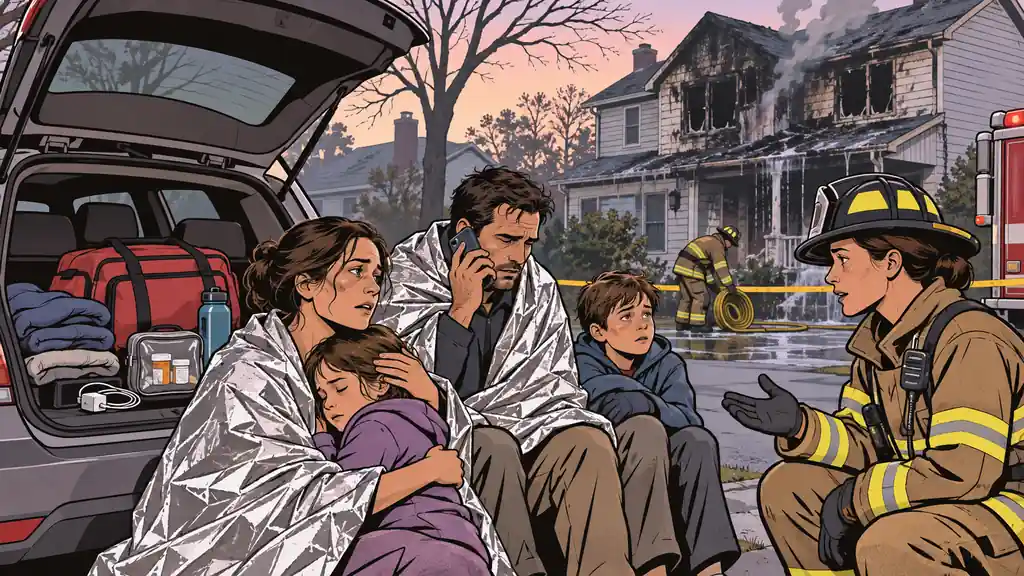
The conventional wisdom for house-fire preparedness stops where the escape ends: everyone’s out, standing at the meeting point, alive. That’s the win, and it’s rightly the priority — the impact score sits high because a fire can kill. But the threat doesn’t stop at the curb. This article will focus on the “second wave” — nowhere to sleep tonight, proving who you are with your papers burned, a coverage gap if insurance never kept up. For the family that survives, the fire’s damage is measured in the months of recovery that follow, and that outcome is decided by preparation done just as far in advance as the smoke alarms. A house fire is one of the few disasters where you can do everything right during the emergency and still be wrecked by the aftermath.
The first night: no home, no stuff
The immediate problem is shelter and basics. The family that thought ahead has an easier night.
- Where you sleep tonight. A relative, a friend, a hotel — decided in the moment, but easier if you’ve thought about who you’d call and whether you can cover a hotel on the spot. A go-bag or a bin of basics kept off-site or in a vehicle — a change of clothes, chargers, some cash — turns a frantic night into a manageable one.
- The immediate cash problem. Everything costs money starting that night: lodging, food, clothes, a phone charger. If your cards and cash burned with the house, and you have no accessible reserve, the first 48 hours are brutal. Some accessible emergency money — not all of it in the house — is part of fire prep, even though it never gets mentioned alongside alarms.
- Medications and essentials. Anyone on a daily medication just lost their supply. Knowing your prescriptions and pharmacy — from a record that didn’t burn — is what gets them replaced quickly.
A grab-and-go folder is an option, but the night is easier still if some basics live outside the house entirely, because the whole point is that the house is gone.
The documents problem: proving who you are and what you’re owed
This is the aftermath failure that hurts longest: after a fire you have to prove who you are and what you’re owed — with your papers burned. Recovery runs on paperwork, and a fire is uniquely good at destroying exactly the paperwork recovery needs.
Think about what a rebuild actually requires:
- Identity documents — IDs, birth certificates, Social Security cards, passports — to do virtually anything official, all of which you’re now doing from scratch.
- The insurance policy itself, so you know your agent, policy number, what you’re owed and can file.
- Proof of what you owned, because insurers pay contents claims against evidence, and “everything, trust me” is not evidence. A home inventory — photos or video of your rooms, closets, and valuables, with receipts for big items — is what turns a contents claim from a guessing match into a documented one.
- Financial and legal records — deeds, titles, account information — to keep your financial life running while the house is rebuilt.
The fix is the simple: keep vital documents backed up off-site — scanned and stored securely, and ideally encrypted — so a total loss can’t also erase your ability to recover. A fire-rated box in the home is a partial measure; an off-site copy is the real one, because it survives even when the house doesn’t. Do the home inventory now, while the house and its contents still exist, because you can’t photograph what’s already ashes.
I’ll take a second and make a plug for a tool on this site. I created the Digital Binder specifically with this need in mind. This tool is an off-site, encrypted storage that’s purpose-built for this kind of data.
The insurance problem: the gap you find at the worst time
The main article’s last point is the quiet killer: a coverage gap if the insurance never kept up with what it costs to rebuild. Insurance is what converts a catastrophic loss into a recoverable one — but only if it’s adequate, and many policies silently aren’t.
- Rebuild cost, not purchase price. Construction costs rise. A policy written years ago to the home’s old value may not cover what it now costs to rebuild — leaving you to make up a large gap out of pocket, at the worst possible moment. Check that your dwelling coverage reflects current rebuild cost.
- Contents coverage and its limits. Personal-property coverage has caps and sometimes sub-limits on categories. Know what yours is, and whether it’s replacement cost or depreciated actual cash value — the difference is large on a total loss.
- Additional living expenses. Good policies cover the cost of living elsewhere while your home is rebuilt — the hotel, the rental, the extra costs. Know whether you have it and how much, because a rebuild can take many months, and that’s a long time to pay for two places to live.
- Renters aren’t exempt. If you rent, the landlord’s policy covers the building, not your belongings or your displacement. Renters insurance is cheap and covers exactly the contents-and-living-expenses problem a fire creates.
The move is an annual look at the policy against today’s rebuild costs — the same cadence as testing the alarms, and just as load-bearing for the outcome.
The timeline nobody plans for
It helps to see the shape of the recovery so the prep makes sense.
- Night one to week one: shelter, immediate cash, replacing critical documents and medications, filing the claim, securing the property.
- Weeks to months: working the insurance claim, documenting the contents loss, arranging temporary housing, and beginning the rebuild or replacement.
- Months to a year-plus: the actual rebuild, restoring your financial and legal footing, and — most importantly if kids are involved — helping the household recover emotionally from losing home and belongings.
Every stage is smoother for the family that pre-staged documents, kept a reserve, did the inventory, and carried adequate coverage. Every stage is a fresh crisis for the family that didn’t.
The common mistakes
- Treating survival as the whole plan. Building a great escape and nothing for the year after.
- All your documents and cash in the house. The one place guaranteed to be gone.
- Never doing a home inventory. Then trying to prove a contents claim from memory, against an insurer that pays on evidence.
- Stale insurance. Coverage written to an old value, discovered inadequate only when you file on a total loss.
- Renting without renters insurance. Assuming the landlord’s policy covers your belongings, when it covers only the building.
Bottom Line
- Getting out is only half — survival is the goal, but the fire’s real cost for the family that lives is the months of recovery after.
- The first night is shelter, cash, and essentials — pre-stage some basics and accessible money off-site, because the house and everything in it is gone.
- Documents decide recovery — keep scanned, encrypted copies off-site, because a fire destroys exactly the paperwork the rebuild needs.
- Do a home inventory now — you can’t photograph contents that are already ashes, and insurers pay contents claims against evidence.
- Right-size insurance annually — dwelling coverage to current rebuild cost, contents and living-expense coverage confirmed, and renters insurance if you rent.
Store scanned IDs, insurance, deeds, and your full home inventory in the encrypted Digital Binder so a total loss can’t erase the paperwork your recovery depends on.